

Why Are People Stockpiling Emergency Supplies? A Canadian Guide
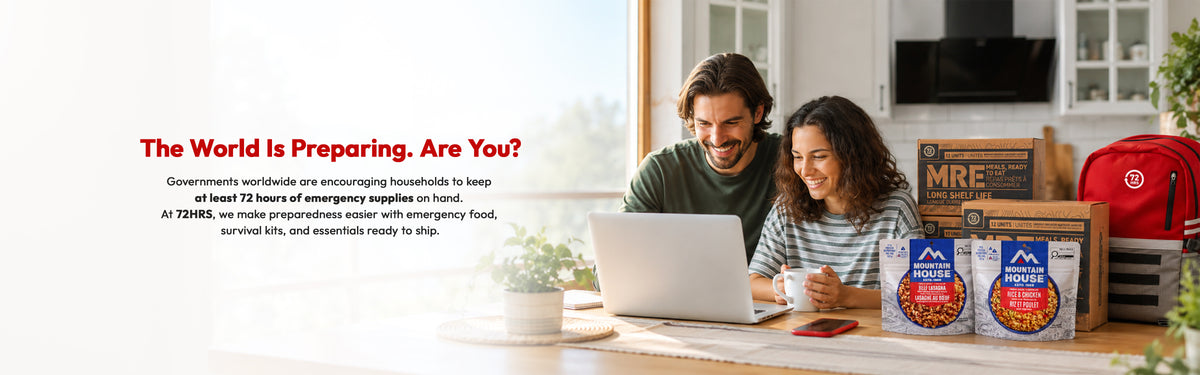
The World Is Preparing. Are You? — A practical guide from 72HOURS. Research checked 5 November 2026.
Emergency supplies are back in the headlines. You may have seen shopping carts filled with bottled water, posts about survival bags, or government advice to keep several days of essentials at home. It raises a reasonable question: should your household be buying more food and supplies, too?
For Canadians, a useful response starts with a clear household plan. Choose a realistic supply target, check what you already own, and fill the gaps with food, water and equipment your family can actually use.
Our campaign asks, “The World Is Preparing. Are You?” This guide explains the recent attention, what Canadian preparedness guidance says, and how to make buying decisions without turning your grocery budget into a collection of emergency products you do not need.
Quick answer: Start with at least 72 hours of household essentials, then adjust for local guidance and personal needs. Prioritize water, usable food, lighting, communication and health supplies. Buy against a written inventory, and check preparation requirements before choosing emergency meals.
Why emergency stockpiling is getting attention now
Recent coverage combines renewed government messaging with visible examples of people buying supplies. These are related developments, but they do not establish that every country faces the same immediate threat.
In the United Kingdom, a local government notice dated 26 October 2026 describes the new Be Ready campaign and its advice to prepare for three days of disruption. The campaign covers interruptions to everyday services, including power and water.
The official Be Ready checklist tells households to check existing supplies and add missing items gradually. That detail matters when a short social post makes ordinary preparedness advice sound like an instruction to buy everything immediately.
On 4 November 2026, SBS reported on emergency-supply purchases and survival-bag posts in South Korea. Its examples show how international news can influence individual shopping decisions. They are not a representative survey of Canadian households or evidence of a Canada-wide shortage.
The European context also predates this week's headlines. The European Commission presented its Preparedness Union Strategy in March 2025, including work on guidance for a minimum of 72 hours of population self-sufficiency.
Taken together, these sources support a measured interpretation: preparedness is receiving fresh attention, while the underlying idea of keeping household essentials has an established policy background. A recommendation to prepare does not, by itself, identify when a particular emergency will happen.
When you encounter a dramatic claim, open the original guidance. Check the publication date, the country, the suggested duration and the actual action requested. Then translate the relevant advice into a shopping list for your own address.
Why do different countries recommend different amounts?
A three-day checklist and a longer household reserve can both appear in legitimate preparedness advice. Read each recommendation in its local context before comparing them. A duration intended for one community should not automatically become the target for every Canadian household.
The same applies to measurements. Guidance may separate drinking water from water for other uses, or combine them into a broader allowance. Read what the number includes before deciding that two checklists contradict each other.
Keep a short note beside your household target explaining which guidance you used. If a new headline appears next week, you can compare it with your existing plan and decide whether anything actually needs updating. This makes the plan easier to maintain without rebuilding the shopping list whenever the conversation online changes.
What should Canadian households prepare for?
Canada's federal emergency-kit guidance says to be ready to support yourself for at least 72 hours. It also emphasizes keeping supplies accessible and making sure household members know where they are.
The target should reflect where you live. The Canadian Red Cross recommends at least three days of supplies, with longer planning periods for some locations: seven to 10 days in remote and northern communities, and 14 days in earthquake- and tsunami-prone regions.
A useful buying exercise is to imagine one ordinary evening with an important service unavailable. What would dinner require without the stove? Could you find a light before your phone battery runs down? Would anyone need assistance leaving the building?
Write down the answers. They identify more useful purchases than a generic photograph of someone else's stockpile.
For a full category-by-category inventory, use our existing 72-hour emergency supplies list. Here, the focus is deciding what deserves a place in your shopping cart.
Set your household target before shopping
Start a worksheet with four details: the people you are planning for, the number of days, the pets or service animals in your care, and any needs that change the plan.
Include the child who stays every second weekend, a relative who regularly visits, or the person whose food choices are limited. Agree on who maintains shared supplies if you live with roommates.
Next, divide your list into three columns: needed, already usable, still to buy. Count only items that are available for the emergency plan. Food you expect to finish tomorrow should not appear as a dependable three-day reserve unless you intend to replace it.
Make the target specific enough to shop from. “Food for four people for three days, including one nut allergy” is actionable. “More emergency food” leaves every promotion looking equally relevant.
Buy water in quantities you can store and handle
Health Canada lists two litres of water per person per day and suggests considering two additional litres for cooking and cleaning. For a three-day plan, the calculation looks like this:
| Household size | Drinking water: 2 L per person daily | Additional cooking and cleaning allowance: 2 L per person daily | Combined planning amount |
|---|---|---|---|
| 1 person | 6 L | 6 L | 12 L |
| 2 people | 12 L | 12 L | 24 L |
| 4 people | 24 L | 24 L | 48 L |
The additional allowance is a planning consideration, and actual needs can differ. Include pets and check the water requirements of every meal you intend to prepare.
Think about handling as well as quantity. Can the person who needs the water lift the container? Can it be poured without moving other heavy items? Will a smaller bottle be easier to take when leaving home?
Measure the storage space before ordering. Several manageable containers may fit your home better than one large container. Keep an inventory that records the amount available, its location and the relevant label instructions.
Compare emergency water options against that worksheet. A package's physical size or number of pouches is less useful than the total litres it adds to your plan.
Choose emergency food around how you will use it
The food in our banner includes MREs and Mountain House meals because households have different preparation and storage priorities. Before choosing a format, answer three questions: who will eat it, what does preparation require, and how much usable food does the package provide?
Begin with familiar shelf-stable food
Look through the pantry for options your household already likes. Depending on individual diets, these might include suitable canned meals, crackers, shelf-stable drinks, fruit cups or snack foods. Check whether each item can be eaten as purchased or needs cooking after opening.
Familiar options make a sensible starting list because you can picture an actual meal. If your household dislikes an item on a normal Tuesday, buying a large quantity for an emergency deserves another thought.
Write a breakfast, lunch, dinner and snack plan before multiplying quantities. Include the utensils and opening tools that the selected packaging requires.
Consider MREs when preparation is a priority
Ready-to-eat entrées can reduce preparation steps. For example, MRE STAR describes its Chicken & Rice entrée as fully cooked and edible cold or heated. Check the particular meal and its accompanying components; a beverage mix or heater may have separate water requirements.
When comparing MREs and ready-to-eat meals, inspect the exact contents. Does the listing describe a complete meal package, an entrée, or a case containing several different components? Read preparation directions and check what accessories are included.
Compare nutrition, dietary suitability and package weight. If a heater is supplied, follow its own instructions and restrictions. Avoid assuming that every product sold in the same category has identical contents or preparation requirements.
Choose a sample quantity before committing to a large order when practical. A trial lets your household assess portions, packaging and flavour while the kitchen is available and there is time to ask questions.
Match freeze-dried meals to your water plan
Mountain House explains that its meals are prepared with added water. Its guidance allows cold-water rehydration with a longer wait, so a lack of hot water does not automatically rule them out. Use safe water and follow the directions applicable to the selected product.
For Mountain House meals, read the directions on each selected product. Record the required water quantity, preparation temperature and waiting time. Check whether the stated servings match the portions your household expects to eat.
A meal belongs in your emergency plan only when its preparation requirements are covered. If your backup setup cannot provide the water or preparation conditions on the label, select another option for that situation.
Compare a few complete menus rather than judging every meal independently. One format may suit your home reserve, while another is easier to carry in a departure bag.
Calculate meals rather than counting packages
For example, a four-person, three-day plan with three planned meals daily contains 36 individual meal occasions, before snacks. That is a menu-planning calculation, not a universal nutritional prescription.
A package marked “36 servings” may contain breakfasts, drinks or side dishes in different proportions. Read the contents and nutrition information to see how those servings become complete days of eating for your household.
Use emergency food packages to compare combinations after you have drafted the menu. Check allergens, dietary needs, preparation requirements and the storage conditions attached to any shelf-life claim.
Add supplies that make the food plan usable
Once you have a food-and-water target, walk through how the household would use it. This catches small omissions that a larger food order cannot solve.
Lighting: Put a tested flashlight or headlamp where it can be found quickly. Check the controls and power source. A light that nobody can operate confidently deserves practice before it becomes part of the plan.
Information and charging: Keep the right cables with your charging equipment. If you are comparing an emergency radio, check its supported bands, power options and instructions. Write down the local information sources you intend to use.
First aid and personal care: Review the contents of your current kit before browsing first aid kits. Add household-specific hygiene items to the shopping list, including the products people routinely rely on.
Warmth and clothing: Set aside suitable clothing and bedding already available at home. Try the clothing on, especially items stored for growing children. Decide what can reasonably fit into the portable portion of the supplies.
Documents and coordination: Gather relevant contact details and document copies in a secure, accessible place. Ask another household member to locate the supplies using your written directions. Their questions will show where the plan needs clearer labels.
For people using electricity-dependent medical equipment or refrigerated medicines, federal power-outage guidance recommends planning with a medical professional. Check the required backup arrangements for the specific equipment and medicine.
Try one evening of the plan before buying more
Choose a convenient evening to rehearse the practical parts while normal services remain available. Keep the household comfortable, leave safety systems operating, and focus on finding and using the supplies you have selected.
Ask someone other than the person who packed the kit to find the light, radio, charging cable and dinner. Can they identify what belongs to whom? Are instructions readable? Can they open the food packaging and locate the utensils?
Prepare one planned meal according to its label. Measure any required water and check the portion against expectations. Record what worked and what was missing. If you discover that the preferred meal needs equipment you do not own, revise the menu before placing a larger order.
Check the portable bag by lifting it and moving it a short, comfortable distance. Reorganize it if everyday essentials are difficult to reach. A household member who cannot move the loaded bag may need a different carrying arrangement.
Finish by replacing anything consumed, recharging the equipment used and updating the shopping list. The exercise should produce a few concrete decisions: perhaps different meal portions, a second cable, clearer labels or smaller water containers. Those findings give the next purchase a clear purpose.
Should you buy a prepared kit or build your own?
A prepared kit can simplify the buying process when you want an organized starting point. Building your own gives you more control over individual choices. A combination can also work: use a kit for selected basics, then add the meals and personal supplies your worksheet identifies.
Compare the itemized contents against your needs before deciding. Pay particular attention to the amount of water, food quantities, dietary compatibility, power requirements, bag dimensions and carrying weight.
Consider who will carry the equipment. A package intended for the household may need to be divided into smaller loads. Check that essential items remain accessible after packing.
Ask yourself what a purchase removes from your to-do list. A complete, suitable package might save assembly time. A duplicate flashlight may add little value if the main gap is still food that requires no preparation.
Browse household emergency kits with the worksheet beside you. Record what the selected kit covers and what you still need to add. The useful comparison is the completed household setup, including any extra purchases.
Build the reserve without overwhelming your budget
If no active emergency requires immediate action, use a gradual shopping plan. Complete the most important gaps first, then expand toward your chosen target as money and space allow.
One approach is to organize purchases into three rounds. In the first round, check existing equipment and add missing water and usable food. In the second, complete lighting, charging and personal items. In the third, improve organization and consider additional days of supply.
Keep a running total of the planned purchases. Include delivery charges and any accessories required to use a product. A low advertised price can be less attractive once the whole setup is counted.
For food, compare the cost of the actual menu. For equipment, compare the function you still need. This keeps a promotional bundle from quietly changing the scope of your plan.
Check current availability and dispatch information before ordering time-sensitive supplies. Delivery timing may differ by product and destination. Avoid relying on a future parcel to solve an immediate household need.
During an active warning or emergency, follow local instructions and purchase limits. Your gradual purchasing schedule should adapt to the situation and the guidance for your community.
Organize supplies for staying home and leaving
A home reserve and a departure bag serve different situations. The Canadian Red Cross distinguishes between shelter-in-place supplies and grab-and-go preparation. Use that distinction when deciding where purchases belong.
At home, group supplies so someone can find a complete meal or the charging equipment without emptying every container. In a portable bag, prioritize the items selected for the departure plan and check the loaded weight.
Label storage locations in plain language. A short contents list on the outside can be more useful than remembering which identical box contains the radio.
Build maintenance into the calendar. The Red Cross recommends reviewing the kit at least annually and replenishing it after use. Follow product labels and any more frequent checks required by particular items.
For pantry items, use an ordinary shopping habit: bring suitable older stock into everyday meals and replace what you use. Update the inventory when household members, diets or equipment change. The reserve should reflect the people living in the home today.
Avoid these buying mistakes
Buying a large quantity before checking the menu. A cupboard can look full while still lacking enough suitable breakfasts or complete meals. Assign purchases to specific days and people.
Treating every serving as a meal. Read the package contents and nutrition panel. Drinks, sides and small portions need to be considered in the full menu.
Forgetting preparation equipment. Put a spoon, opening tool or other required item beside the food that needs it. Try the sequence once before storing everything away.
Assuming outdoor cooking equipment can be used inside. Government of Canada guidance says not to use outdoor fuel-burning equipment such as barbecues, camping stoves or portable burners indoors, including in garages or basements. Choose food appropriate to the preparation arrangements you can safely provide.
Letting a headline determine the order size. Return to your household target. If a purchase does not fill a documented gap, leave it for later consideration.
Questions about emergency stockpiling
Does new preparedness advice mean a disaster is imminent?
The advice discussed here describes preparation for disruption; it does not establish that a specific disaster is imminent in Canada. Check local alerts and original official statements for information relevant to your area.
Is 72 hours enough for everyone?
It is the federal starting point. Some communities and locations need longer plans, and personal needs can change what supplies are appropriate. Consult local guidance before choosing the final duration.
Do I need specialist emergency food?
Your plan can include suitable grocery items, specialist meals or a combination. Compare the complete menu, preparation requirements and storage instructions. Familiarity and practical usability should guide the choice.
How do I know when to stop buying?
Stop when the worksheet's gaps are filled for your chosen duration and you have checked that the supplies work together. Schedule maintenance and review the target when circumstances change.
The world is preparing. Start with your household.
You can turn today's headlines into a practical task: count the people, choose the planning period and check the cupboard. Write down the gaps, then select supplies that fit the menu, storage space and people who will use them.
Start by comparing emergency food packages, MREs and Mountain House meals. Complete the plan with the water, kit and personal items your household needs. Check each product's current details and shipping information before placing an order.





Leave a comment